

Arthur Conan Doyle

Life Events
| Date | Event | Details |
|---|---|---|
22 May 1859 | Birth | Born Arthur Ignatius Conan Doyle in Edinburgh, Scotland, the third of ten children in an Irish Catholic family. He studied medicine at the University of Edinburgh, where he encountered Dr Joseph Bell, whose remarkable powers of observation and deduction would become the primary model for Sherlock Holmes. He practiced as a physician before the success of his writing allowed him to abandon medicine entirely. |
9 August 1902 | Appointment | Appointed Knight Bachelor in the Coronation Honours of Edward VII, the award recognising his pamphlet The War in South Africa: Its Cause and Conduct, in which he defended British military conduct during the Boer War to an international audience. Doyle had initially declined the honour twice before accepting, uncomfortable with the establishment recognition it represented. The knighthood was awarded for his political and journalistic work rather than his fiction, a distinction Doyle noted with characteristic ambivalence given that Sherlock Holmes had by this point made him the most recognisable British author in the world. |
7 July 1930 | Death | Died of a heart attack at his home Windlesham Manor in Crowborough, Sussex, aged 71. By the time of his death Doyle had published four Sherlock Holmes novels and fifty-six short stories spanning four decades, as well as historical novels, science fiction, and a substantial body of work on spiritualism, to which he had devoted much of his later life. He was buried in the garden of Windlesham Manor before being reinterred at All Saints' Churchyard in Minstead, Hampshire. |
Birth22 May 1859
Born Arthur Ignatius Conan Doyle in Edinburgh, Scotland, the third of ten children in an Irish Catholic family. He studied medicine at the University of Edinburgh, where he encountered Dr Joseph Bell, whose remarkable powers of observation and deduction would become the primary model for Sherlock Holmes. He practiced as a physician before the success of his writing allowed him to abandon medicine entirely.
Appointment9 August 1902
Appointed Knight Bachelor in the Coronation Honours of Edward VII, the award recognising his pamphlet The War in South Africa: Its Cause and Conduct, in which he defended British military conduct during the Boer War to an international audience. Doyle had initially declined the honour twice before accepting, uncomfortable with the establishment recognition it represented. The knighthood was awarded for his political and journalistic work rather than his fiction, a distinction Doyle noted with characteristic ambivalence given that Sherlock Holmes had by this point made him the most recognisable British author in the world.
Death7 July 1930
Died of a heart attack at his home Windlesham Manor in Crowborough, Sussex, aged 71. By the time of his death Doyle had published four Sherlock Holmes novels and fifty-six short stories spanning four decades, as well as historical novels, science fiction, and a substantial body of work on spiritualism, to which he had devoted much of his later life. He was buried in the garden of Windlesham Manor before being reinterred at All Saints' Churchyard in Minstead, Hampshire.
Reading Orders
Universes (1)
Series (2)
The Novels
Sherlock Holmes
The four Sherlock Holmes novels form the structural backbone of the canon, introducing the universe's central characters and establishing its most substantial plots. A Study in Scarlet presents the first meeting of Holmes and Watson and sets out the consulting detective's method in full; The Sign of Four deepens their partnership while introducing one of the canon's more personally consequential cases; The Hound of the Baskervilles, the most celebrated and self-contained of the four, sends Holmes and Watson to the Devon moors for the canon's most atmospheric investigation; and The Valley of Fear, the final novel, returns to the theme of organised crime and secret societies that runs through the earlier work. The novels reward reading in publication order but The Hound of the Baskervilles functions as a natural entry point for newcomers encountering Holmes for the first time.
The Short Stories
Sherlock Holmes
Books (9)
A Study in Scarlet
The Novels
1887
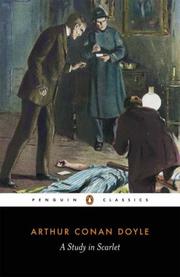
The first Sherlock Holmes story, introducing the consulting detective and his companion Dr John Watson through a London murder investigation with roots in the Mormon settlements of Utah. Doyle establishes Holmes's method of deductive reasoning, the Baker Street setting, and the central partnership that would define the canon. The novel's structure is unusual, splitting between the London investigation and a lengthy American flashback that some readers find disruptive but which establishes the murderer's motive with considerable force.
The Sign of Four
The Novels
1890
The second Holmes novel, commissioned directly by the editor of Lippincott's Monthly Magazine at a dinner that also produced Oscar Wilde's The Picture of Dorian Gray. The investigation centres on a stolen treasure, a wronged woman, and a chase along the Thames, and introduces Mary Morstan. The Sign of the Four deepens Holmes's characterisation considerably, including his cocaine use and his philosophical outlook, while delivering a more conventionally satisfying adventure plot than its predecessor.