Explore characters, series and universes across the fiction you love. Set your reading progress and we'll filter everything to match - no accidental reveals, no surprises, no ruined moments.
No spoilers beyond this point.
Popular
Help shape the site
Content the community has asked for. Vote on what should be added next.
Recently added

Characters
View all →- D
- A
- N
- R
- P
- S
- E
- F
Universes
View all →
The Malazan World
1 series
The Malazan World is one of the most expansive and densely realised settings in epic fantasy, spanning multiple continents, thousands of years of history, and a cast of hundreds. Created by Steven Erikson and Ian Cameron Esslemont, the world is defined by its scope and complexity - ancient races who have outlived their gods, empires built and broken across geological time, and a magic system rooted in the warrens, mysterious paths of power that connect the living world to something older and stranger beneath it. At the centre of the core sequence is the Malazan Empire, a military superpower whose campaigns across the world drive much of the narrative - though the series consistently complicates any simple reading of conquest and resistance. The story is told from dozens of perspectives across thousands of miles, with characters disappearing for entire volumes before resurfacing changed, and events whose significance only becomes clear books later. The world's history is geological in scale. The T'lan Imass made a ritual choice three hundred thousand years ago that still shapes the present. The Tiste Andii have watched civilisations rise and fall with something beyond weariness. The Jaghut built a world and then dismantled it. Understanding what happened before the first page is part of reading Malazan - the present is always haunted by a past of enormous violence and consequence.

The Therin Continent
1 series
The world of Scott Lynch's Gentleman Bastard sequence, centred on the city-states of the Therin Throne's former empire - among them Camorr, Tal Verrar, and Karthain - built atop the ruins and elderglass structures left by a vanished people called the Eldren. The continent's city-states are defined by their commerce, their political intrigue, and the criminal hierarchies that operate beneath their official structures. Lynch's world-building is dense with historical texture and mercantile detail, and the mystery of the Eldren civilisation provides a mythological underpinning whose full implications remain unexplored across the published novels.

The Wheel of Time
1 series
The world of Robert Jordan's epic sequence has no canonical name - its inhabitants simply call it the world - but it is one of the most elaborately constructed secondary worlds in fantasy fiction. Shaped by the Wheel of Time itself, which spins the Pattern of Ages and weaves the lives of men and women into its design, it is a world haunted by a previous Age of legend and by the knowledge that the Dark One, imprisoned at the moment of creation, is weakening his bonds. The one Power, the various nations of the Westlands, the Aiel Waste, and the continent of Seanchan together form a geography of extraordinary depth and internal consistency.

All-World
1 series
The vast multiverse conceived by Stephen King across the Dark Tower series, encompassing not only Roland Deschain's dying world but the many parallel universes connected by the Dark Tower at the centre of existence. All-World is the term Roland's people use for their own reality - a world that has moved on, its technology failing, its geography distorted, its population dwindling - but the universe extends far beyond it to include versions of our own world and countless others. The Tower itself is the linchpin of all realities, and its threatened collapse is the central concern of the entire sequence.

Realm of the Elderlings
5 series1 book
The Realm of the Elderlings is the creation of Robin Hobb, a secondary world fantasy universe built across five trilogies and a standalone novel published between 1995 and 2017. Set primarily in the Six Duchies, the Bingtown Trader coast, and the Rain Wilds, it is a universe defined less by its world-building than by the depth and honesty of its character work - Hobb's sustained examination of what it costs to live an exceptional life in a world that does not reward exceptionalism cleanly. Magic in this universe takes several forms - the Skill, a telepathic ability used by the Farseer royal line; the Wit, a bond between humans and animals regarded with suspicion and fear; and the mysterious transformative power of the Rain Wilds that shapes both its human inhabitants and the living ships of the Bingtown Traders. Dragons, Elderlings, and the ancient civilisation that preceded the current world provide a mythological depth that reveals itself gradually across the full sequence.

His Dark Materials
2 series4 books
A multiverse of parallel worlds connected by invisible threads of Dust - elementary particles that accumulate around conscious beings and that different cultures variously interpret as sin, dark matter, or the physical substrate of the soul. The universe is most fully realised through the world of Lyra Belacqua, an alternative Earth where the Catholic Church never lost its grip on European civilisation and every human is accompanied by a daemon - an animal-shaped external manifestation of their soul that can speak, feel, and change form until the onset of adulthood fixes its shape permanently. Pullman's universe is distinguished by the seriousness with which it treats its central questions - consciousness, free will, the nature of growing up, and the institutional tendency to confuse authority with truth. Built across six novels spanning several decades of Lyra's life, it is one of the richest and most philosophically engaged secondary world constructions in contemporary fiction.
Series
View all →The Wheel of Time
by Brandon Sanderson, Robert Jordan
Robert Jordan's The Wheel of Time is one of the most ambitious and influential epic fantasy series ever written - 14 novels spanning over four million words, thousands of named characters, and a richly detailed world built on mythology from dozens of cultures. The story begins with five young people from a remote village drawn into a struggle against the Dark One, the embodiment of evil imprisoned since the creation of the world, and follows them as they discover their roles in a prophecy that may save or destroy civilisation. Jordan published the first eleven books between 1990 and 2005 before his death in 2007 from a rare blood disease. Working from Jordan's extensive notes and outlines, Brandon Sanderson completed the final three volumes, bringing the series to its conclusion in 2013. The Wheel of Time has sold over 90 million copies worldwide and has been adapted as an Amazon Prime Video television series.
Malazan Book of the Fallen
by Steven Erikson
One of the most ambitious works in epic fantasy, the Malazan Book of the Fallen follows the campaigns of the Malazan Empire and the forces that resist, survive, and outlast it across multiple continents and thousands of years of accumulated history. The series is told from dozens of perspectives - soldiers, gods, assassins, ancient races, and ordinary people caught in the machinery of empire - with no single protagonist anchoring the whole. Characters disappear for entire volumes before resurfacing changed; events whose significance is obscure in one book resolve into clarity three books later. The series is notable for its deliberate refusal to explain itself. Gods, warrens, ancient races, and historical cataclysms are presented without preamble, trusting the reader to accumulate understanding gradually. This makes the opening books among the most demanding entry points in the genre and the later books among the most rewarding. The Malazan Book of the Fallen rewards patience and rereading in ways that few series match. The ten-book sequence concludes with Dust of Dreams and The Crippled God, written and published as a single narrative split across two volumes.

The Expanse
by James S. A. Corey
Nine novels following the crew of the Rocinante - a salvaged Martian warship captained by James Holden - across more than four decades of solar system politics, war, and first contact. The series spans three loose acts: a conspiracy thriller set within the solar system, an expansion through alien gates to a thousand new worlds, and a final reckoning with whatever destroyed the civilisation that built them. Written by Daniel Abraham and Ty Franck under the pen name James S.A. Corey, the series won the Hugo Award for Best Series in 2020 and is complete at nine books.

The Culture
by Iain M. Banks
The Culture series is a science fiction series written by Scottish author Iain M. Banks and released from 1987 until 2012. The stories centre on The Culture, a utopian, post-scarcity space society of humanoid aliens and advanced superintelligent artificial intelligences living in artificial habitats spread across the Milky Way galaxy. The main themes of the series are the dilemmas that an idealistic, more-advanced civilization faces in dealing with smaller, less-advanced civilizations that do not share its ideals, and whose behaviour it sometimes finds barbaric. In some of the stories, action takes place mainly in non-Culture environments, and the leading characters are often on the fringes of (or non-members of) the Culture, sometimes acting as agents of Culture (knowing and unknowing) in its plans to civilize the galaxy. Each novel is a self-contained story with new characters, although reference is occasionally made to the events of previous novels.
The Dark Tower
by Stephen King
Eight novels written by Stephen King between 1982 and 2012, following Roland Deschain - the last gunslinger - on his quest across a dying world toward the Dark Tower, the nexus of all realities. The series defies easy categorisation: it is a western, a horror novel, a post-apocalyptic epic, and a high fantasy quest, held together by King's mythology of ka - fate - and a cast that grows from a lone figure in the desert to a fully realised fellowship. Begun when King was nineteen and completed over four decades, it is widely regarded as his magnum opus. Inspired by Robert Browning's poem "Childe Roland to the Dark Tower Came" and Sergio Leone's spaghetti westerns, it eventually grew to connect with much of King's wider fiction, though the eight core novels stand entirely on their own.

Rincewind / The Wizards
by Terry Pratchett
Rincewind is the Disc's most useless wizard - he can't even spell "wizzard," and his most notable talent is running away very fast. Beginning with The Colour of Magic, these were Pratchett's earliest Discworld novels, initially written as parodies of fantasy before evolving into broader satire. The other wizards of Unseen University aren't much better, spending more time studying the common room biscuit tin than mystical tomes, though they occasionally stretch to some magic between elevenses. Across eight books, Rincewind is dragged into adventures spanning the entire Disc - from the Counterweight Continent to ancient civilisations to XXXX - while the Unseen University faculty, led by Archchancellor Ridcully, provide a recurring ensemble. Unseen Academicals shifts focus almost entirely to the university itself. The series establishes much of Discworld's cosmology, geography, and the Luggage - Rincewind's homicidal travelling companion.
Books
View all →
White Sand
by Brandon Sanderson, Rik Hoskin
On the planet Taldain, one side faces perpetual daylight and the other endless twilight. On the sunlit Dayside, a vast desert dominates the landscape, and the sand itself holds power - white when charged with Investiture from the sun, black when spent. Sand masters can command this sand telekinetically, shaping it into weapons, shields, and tools, but only while standing in sunlight and only at the cost of dehydrating themselves. Kenton is the weakest sand master in the Diem, the guild that has protected and governed sand mastery for centuries. When a devastating massacre wipes out nearly every sand master, Kenton survives and finds himself the acting Lord Mastrell of a guild on the brink of dissolution. The Taishin - Dayside's ruling council - see an opportunity to finally disband the Diem and seize its power. Kenton has two weeks to prove the guild's worth or lose everything his people have built. Meanwhile, Khrissalla, a duchess from Darkside, has crossed the ocean and the brutal border storm in search of a legendary power she believes can save someone she loves. Her arrival on Dayside sets in motion a collision between two cultures that have spent centuries ignoring each other, and draws the attention of forces far older than either. Originally written as a prose novel and adapted into a graphic novel trilogy illustrated by Julius Gopez, Nabetse Zitro, and Fritz Casas. Set on Taldain in the Cosmere, where the Shard Autonomy watches over a world divided between light and dark.
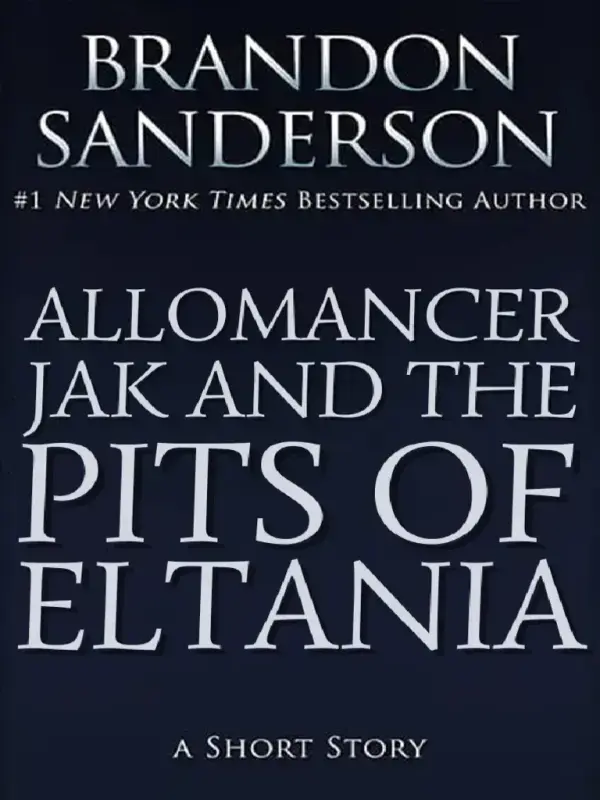
Allomancer Jak and the Pits of Eltania
by Brandon Sanderson
Allomancer Jak is the self-proclaimed greatest adventurer in the Elendel Basin, and he wants you to know it. Presented as a serialised collection of letters to his adoring readers - with exasperated footnotes from his long-suffering Terris steward Handerwym correcting his exaggerations at every turn - this tale follows Jak's expedition into the wilds in search of the legendary Survivor's Treasure. Captured by a koloss tribe after killing their champion in what he assures you was a perfectly fair duel, Jak finds himself dragged to a hidden holy site: an enormous natural pool surrounded by ancient stonework. There he discovers that his travelling companion Elizandra Dramali has been concealing her koloss-blooded heritage, and that the tribe intends to make Jak one of their own by driving metal spikes through his body. With his Allomancy restored through an unlikely kiss, Jak dives to the bottom of the pool to retrieve a treasure that can only be "raised by life itself" - and what he finds changes the fortunes of both the tribe and himself. A comedic short story set on Scadrial during the Wax and Wayne era of the Cosmere. Equal parts pulp adventure serial and affectionate parody, best enjoyed with close attention to Handerwym's footnotes, which tell a rather different story than Jak's.

The Collectors
by Philip Pullman
A gothic companion tale set in the world of His Dark Materials, offering a chilling glimpse of the young woman who will one day become Mrs Coulter - one of fiction's most compelling villains. On a cold winter's night, two art collectors sit before a fire in the senior common room of an Oxford college, admiring two recently acquired pieces: a portrait of a striking young woman and a bronze sculpture of a fearsome monkey. As they discuss the works' provenance, the story behind the art reaches across time and worlds to find them. A standalone story that does not feature Lyra or the familiar cast of the trilogy, The Collectors instead illuminates the origins of Pullman's most dangerous creation through an atmosphere of mounting dread.

Serpentine
by Philip Pullman
A short story set five years after The Amber Spyglass and two years before The Secret Commonwealth. Lyra and Pantalaimon return to the northern town of Trollesund - where they first met Iorek Byrnison and Lee Scoresby - accompanying an archaeological expedition. But Lyra has a private purpose: to seek out the witch-consul Dr Lanselius and ask about a secret condition that has haunted her since the events of the trilogy - the disturbing discovery that she and Pan can separate, something no human and dæmon should be able to do. What unfolds is a quiet, revelatory conversation that foreshadows the central crisis of The Book of Dust. Originally written in 2004 for a charity auction at the National Theatre, published sixteen years later.
Gardens of the Moon
by Steven Erikson
The opening volume of the Malazan Book of the Fallen, set against the Malazan Empire's siege of the city of Darujhistan on the continent of Genabackis. The Bridgeburners - a veteran military company in imperial service - are caught between the ambitions of the Empress and the machinations of the gods, while in Darujhistan a circle of young thieves becomes entangled in forces far beyond their understanding. Gardens of the Moon introduces the world without explanation, dropping the reader into a conflict already in motion and trusting them to find their footing.

Fool's Assassin
by Robin Hobb
The opening novel of the Fitz and the Fool Trilogy returns to FitzChivalry Farseer decades after the conclusion of the Tawny Man Trilogy, finding him settled into a quiet life at Withywoods with Molly. Hobb takes her time with the opening - the novel's first half is deliberately unhurried, documenting the texture of an older Fitz's domestic life with a patience that makes what follows considerably more devastating. The arrival of a mysterious child and the reappearance of threads from across the full sequence draw Fitz back into a world he believed he had left behind. Fool's Assassin introduces Bee Farseer, Fitz's unexpected daughter, as a major point of view character whose perspective on the world is among the most distinctive in the sequence. The novel's second half is among the most upsetting in the Elderlings universe.
Authors
View all →
Rik Hoskin
1 book
British comic book writer and adapter, known for translating prose fiction into graphic novel scripts. His adaptation credits include Brandon Sanderson's White Sand trilogy and work for publishers including Marvel, Dark Horse, and Titan Comics.

Steven Erikson
1 series10 books
Steven Erikson is the pen name of Steve Rune Lundin, a Canadian author and archaeologist born on 7 October 1959 in Toronto, Ontario. His background in archaeology and anthropology shapes the Malazan world at every level - the series approaches its fictional civilisations with the detachment of a field researcher cataloguing a dig, interested in systems and structures as much as individuals. Erikson studied at the University of Victoria and the Iowa Writers' Workshop, and worked as an archaeologist before turning to fiction full time. The Malazan Book of the Fallen began as a role-playing game world developed with Ian Cameron Esslemont in the 1980s, eventually growing into one of the most ambitious projects in epic fantasy. Gardens of the Moon was completed in the late 1980s but rejected by publishers for over a decade before finally appearing in 1999. The series concluded with The Crippled God in 2011. Erikson has since published the Kharkanas Trilogy, a prequel sequence set in the Malazan world's distant past, as well as the Witness trilogy continuing the main sequence storyline.

Robin Hobb
5 series17 books
Robin Hobb is the pen name of American author Margaret Astrid Lindholm Ogden, who also publishes fantasy fiction under the name Megan Lindholm. Born in California in 1952 and raised in Alaska and Washington State, she began publishing as Megan Lindholm in the 1980s before adopting the Robin Hobb name for the Farseer Trilogy in 1995. The two names represent genuinely distinct bodies of work rather than a simple rebranding - the Lindholm novels are smaller in scale and more intimate, while the Hobb novels are characterised by their emotional intensity, long-form character development, and willingness to subject protagonists to sustained suffering. The Realm of the Elderlings sequence, published across three decades, is widely regarded as one of the finest achievements in contemporary epic fantasy for the depth of its characterisation and the uncompromising honesty of its emotional register.
From the Reading Room
View all →
Under the Hood: Speed, Search, and Accessibility
15 May 20263 min readThe last few weeks have been focused on making OpenFiction faster, easier to search, and more accessible. None of these changes are as visible as adding a new universe, but they affect every page on the site.

Every Book Now Has Chapter Summaries - Plus 1,300 Glossary Entries
15 May 20263 min readWhen we launched OpenFiction's beta, the database had characters, books, and a spoiler system – but most books were empty shells. You could see that Kaladin appeared in The Way of Kings, but there was no way to browse what happened chapter by chapter, or to look up what "Allomancy" actually means without leaving the site. That's changed. Every one of the 252 books in the database now has chapter summaries with entity links, and we've built a glossary covering every universe on the site.

Explore Any Book Chapter by Chapter - Without the Spoilers
18 April 20264 min readYou're halfway through The Well of Ascension. A character appears whose name you half-remember from a hundred pages ago. You want to know who they are, what their deal is, where they fit into the story. So you open a browser tab. And immediately close it again.