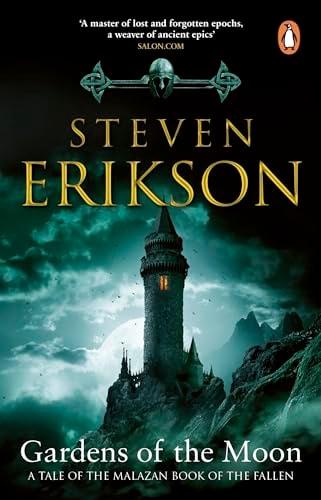
Gardens of the Moon
24 chapters - View chapters and summaries
Characters (57)
| Name | Role |
|---|---|
Anomander Rake Lord of Moon's Spawn and leader of the Tiste Andii, an ancient people of darkness who have outlasted most of what they once cared about. Anomander Rake is among the most powerful beings in the Malazan world, carrying a sword called Dragnipur whose nature is itself a kind of story. He is defined by the combination of immense power and genuine weariness, and by a code whose contours become clearer across the sequence. | Major |
Antsy A Bridgeburner sergeant known for his nervous disposition and perpetual anxiety. Despite his anxious nature, Antsy is a competent soldier and a reliable member of the Bridgeburners. | Minor |
Apsalar A young fisher's daughter from a coastal village who was possessed by the god Cotillion and used as an instrument of assassination before being encountered by the Bridgeburners. Apsalar is defined by the difficulty of reclaiming an identity after it has been occupied by something else, and by skills she did not choose and cannot entirely discard. | Major |
Baruk A High Alchemist and one of the senior members of Darujhistan's T'orrud Cabal. Baruk is defined by the tension between his considerable power and his institutional caution - he is capable of decisive action but prefers to understand a situation fully before committing to it. | Supporting |
Bellurdan A Thelomen High Mage in service to the Malazan Empire. Bellurdan is a giant of a man, towering over ordinary humans, and a powerful practitioner of magic. The partner of Nightchill and a soldier-mage whose particular bond with her shapes a great deal of how the Siege of Pale and its aftermath play out for him. | Minor |
Caladan Brood The warlord commanding the principal military alliance opposing the Malazan Empire on Genabackis, Caladan Brood is a figure of immense physical power who carries a hammer said to be capable of ending the world. He is deliberate, patient, and possessed of a strategic intelligence that has kept a coalition of disparate forces functioning across years of war. | Major |
Calot A Malazan mage and the lover of Tattersail. A steady, capable practitioner of the Empire's cadre magic whose particular bond with Tattersail gives the Siege of Pale - and its aftermath for her - some of its more personal weight. | Minor |
Challice A young noblewoman of Darujhistan and daughter of one of the city's prominent families. Beautiful and politically astute, Challice navigates the treacherous social waters of Darujhistan's nobility. | Minor |
Chert A thief and petty criminal operating in the lower circles of Darujhistan's underworld. Chert becomes involved in the events surrounding Crokus Younghand. | Minor |
Circle Breaker A secret agent of the Eel who operates within Darujhistan's Council of Nobles. Circle Breaker risks his life passing intelligence about the Council's dealings to the Eel's network, living in constant fear of discovery. | Minor |
Coll A nobleman of Darujhistan who has fallen on hard times. Once a man of wealth and standing, Coll lost his estates through political machinations and now spends his days drinking at the Phoenix Inn. Despite his decline, he retains his honour and proves himself a loyal friend when it matters most. | Supporting |
Cotillion One of the two gods who rule the Realm of Shadow, Cotillion is the patron of assassins and one of the sequence's most active divine participants in mortal affairs. Where Shadowthrone operates through misdirection, Cotillion is more direct - he intervenes personally and is bound by a personal code that distinguishes him from the series' more purely transactional divine figures. | Major |
Crokus Younghand A young thief operating across Darujhistan's rooftops, Crokus Younghand is drawn into events considerably beyond his experience when a routine theft places him at the intersection of imperial and divine interest in the city. He is defined by the combination of competence in his chosen field and complete unpreparedness for everything surrounding it. | Supporting |
Crone An ancient Great Raven and the matriarch of the murder of Great Ravens allied with Anomander Rake and the Tiste Andii of Moon's Spawn. Crone serves as Rake's messenger and scout, carrying intelligence across vast distances. She is cunning, sarcastic, and fiercely intelligent, often providing sardonic commentary on the affairs of mortals and gods alike. | Supporting |
Dancer The former companion and co-conspirator of Emperor Kellanved, and one of the most skilled assassins in the history of the Malazan Empire. Dancer was believed killed alongside Kellanved during Laseen's coup. He is believed to have Ascended to become Cotillion, the Patron of Assassins and the Rope of High House Shadow. | Supporting |
Dassem Ultor The former First Sword of the Malazan Empire and arguably the greatest swordsman in the world. Dassem Ultor held the title of Champion of the empire before his apparent death. His legacy casts a long shadow over the military forces of the empire. | Minor |
Derudan A witch of Darujhistan and a member of the T'orrud Cabal, the secret group of mages who protect the city from magical threats. Derudan is a powerful practitioner whose abilities complement those of the other Cabal members. | Minor |
Dujek Onearm The High Fist commanding the Malazan forces on Genabackis, Dujek Onearm is one of the empire's most capable military commanders - trusted by his soldiers rather than, necessarily, by his empress. He operates at the intersection of military necessity and political reality, aware that the orders he receives and the situation on the ground rarely align. | Major |
Empress Laseen The ruler of the Malazan Empire, Laseen came to power through the Claw and has maintained that power through a combination of political ruthlessness and calculated distance from the empire's military campaigns. She is one of the sequence's most deliberately ambiguous figures - her decisions cause enormous suffering, and the sequence neither excuses nor simply condemns her. | Antagonist |
Fiddler A sapper and one of the Bridgeburners' longest-serving members, Fiddler is defined by a sardonic pragmatism that functions as both coping mechanism and genuine philosophy. He is exceptionally good at his work and exceptionally tired of the circumstances that require it. His card readings recur across the sequence as moments of unwanted clarity. | Major |
Showing 1 to 20 of 57 items
Page 1 of 3
Groups (10)
| Name | Type |
|---|---|
| Groups in Malazan Book of the Fallen (series) | |
| Circle of Kruppe | Community |
| The Anti-Malazan Alliance | Organisation |
| The Bonehunters | Faction |
| The Bridgeburners | Faction |
| The Claw | Organisation |
| The Malazan Empire | Organisation |
| The Realm of Shadow | Faction |
| The T'lan Imass | Faction |
| The T'orrud Cabal | Organisation |
| Tiste Andii | Faction |
History
| Date | Event | Details |
|---|---|---|
1 April 1999 | Publication | Gardens of the Moon received a mixed but intrigued critical reception on publication, with reviewers divided between admiration for its ambition and frustration with its demands. The novel's refusal to orient the reader - dropping them into an ongoing conflict with no preamble - was praised by some as bold and condemned by others as wilfully obscure. Erikson's worldbuilding drew consistent praise: the depth of the Malazan world, the sense of a history extending far beyond the immediate narrative, and the scale of the magic system were all noted as genuinely distinctive. The Bridgeburners were widely regarded as the novel's emotional core, with Whiskeyjack and the veteran soldiers providing a human anchor in an otherwise overwhelming landscape. Gardens of the Moon has since been substantially reassessed and is now widely regarded as the beginning of one of the genre's most significant achievements, its initial difficulty reframed as intentional design rather than failure of craft. |
2000 | Award Nominated | World Fantasy Award Best Novel. |
2 July 2000 | Award Nominated | Locus Award Best First Novel. 15th place. |
Publication1 April 1999
Gardens of the Moon received a mixed but intrigued critical reception on publication, with reviewers divided between admiration for its ambition and frustration with its demands. The novel's refusal to orient the reader - dropping them into an ongoing conflict with no preamble - was praised by some as bold and condemned by others as wilfully obscure. Erikson's worldbuilding drew consistent praise: the depth of the Malazan world, the sense of a history extending far beyond the immediate narrative, and the scale of the magic system were all noted as genuinely distinctive. The Bridgeburners were widely regarded as the novel's emotional core, with Whiskeyjack and the veteran soldiers providing a human anchor in an otherwise overwhelming landscape. Gardens of the Moon has since been substantially reassessed and is now widely regarded as the beginning of one of the genre's most significant achievements, its initial difficulty reframed as intentional design rather than failure of craft.
Award Nominated2000
World Fantasy Award
Best Novel.
Award Nominated2 July 2000
Locus Award
Best First Novel. 15th place.