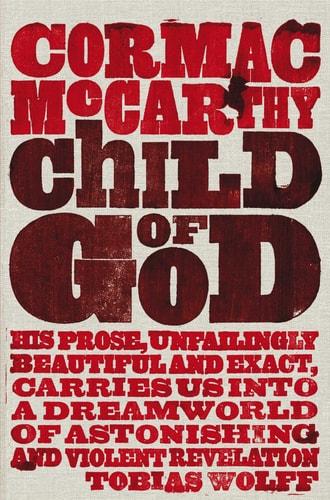
Child of God
53 chapters - View chapters and summaries
Characters (8)
| Name | Aliases | Role |
|---|---|---|
Lester Ballard Dispossessed of his Tennessee farm by a county auctioneer, Lester Ballard descends into ever more extreme isolation and violence in the surrounding hills. McCarthy presents him as "a child of God much like yourself perhaps" - the novel's most unsettling provocation. He is shaped by dispossession, loneliness, and a world that has never once offered him a place in it. | Protagonist | |
Fate Turner The high sheriff of Sevier County. A plainspoken, competent lawman who investigates the disappearances connected to the Frog Mountain turnaround. | Supporting | |
Reubel The dumpkeeper who lives at the edge of the quarry dump with his large family. He named his many daughters from an old medical dictionary and has largely lost control of his household. | Supporting | |
C B The auctioneer hired to sell Lester Ballard's family property. A confident and unflappable man who refuses to back down even when confronted at gunpoint. | Minor | |
Fred Kirby A local man who makes and hides moonshine whiskey. He sits in his front yard by the watertap and deals in small trades with his neighbours. | Minor | |
John Greer A man from Grainger County who purchases Ballard's family property at auction and takes up residence there. | Minor | |
Mr Fox The owner of a local general store where Ballard shops on credit. A practical man who keeps a running tally of Ballard's mounting debt. | Minor | |
Mr Wade An elderly resident of Sevierville, born in 1885, who remembers the history of the White Caps and the public hangings on the courthouse lawn. | Minor |
History
| Date | Event | Details |
|---|---|---|
1973 | Publication | Harold Bloom listed it among the works of contemporary American literature he predicted would endure. Studied extensively in academic circles. Later adapted into a film directed by James Franco. Divisive on publication and remains so - it is among McCarthy's most debated novels in terms of what it demands of the reader. |
Publication1973
Harold Bloom listed it among the works of contemporary American literature he predicted would endure. Studied extensively in academic circles. Later adapted into a film directed by James Franco. Divisive on publication and remains so - it is among McCarthy's most debated novels in terms of what it demands of the reader.