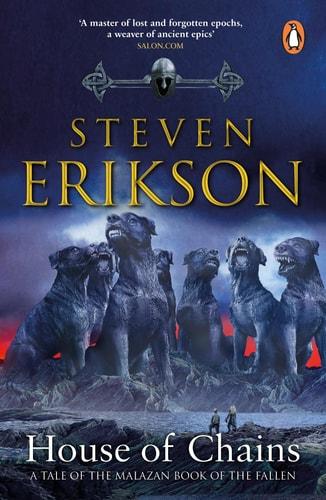
House of Chains
26 chapters - View chapters and summaries
Characters (64)
| Name | Role |
|---|---|
Anomander Rake Lord of Moon's Spawn and leader of the Tiste Andii, an ancient people of darkness who have outlasted most of what they once cared about. Anomander Rake is among the most powerful beings in the Malazan world, carrying a sword called Dragnipur whose nature is itself a kind of story. He is defined by the combination of immense power and genuine weariness, and by a code whose contours become clearer across the sequence. | Major |
Apsalar A young fisher's daughter from a coastal village who was possessed by the god Cotillion and used as an instrument of assassination before being encountered by the Bridgeburners. Apsalar is defined by the difficulty of reclaiming an identity after it has been occupied by something else, and by skills she did not choose and cannot entirely discard. | Major |
Apt An Aptorian demon from the Shadow realm who has adopted and fiercely protects a young boy. Apt is a deadly creature whose maternal instinct toward the child creates one of the novel's stranger and more affecting relationships. | Minor |
Bairoth Gild A Teblor warrior of the Uryd tribe and one of Karsa's companions on his raid into the lowlands. Bairoth is strong and capable but lacks Karsa's single-minded certainty, harbouring doubts about their mission and the truths of Teblor history. | Minor |
Bidithal A High Mage of the Whirlwind rebellion and a deeply malevolent figure. Bidithal is a practitioner of the Shadow warren who pursues his own agenda within the rebellion, driven by personal obsessions and cruelty that make him dangerous even to his supposed allies. | Antagonist |
Blistig The Fist commanding the Aren garrison. Blistig is a competent officer who finds himself increasingly frustrated by High Fist Pormqual's cowardice and political manoeuvring as the rebellion closes in on the last Malazan stronghold in Seven Cities. | Supporting |
Bottle A young Malazan mage in the 14th Army with an unusual connection to spirits and the natural world. Bottle's magic is instinctive rather than formal, drawing on a talent for communicating with animals and spirits that makes him valuable for reconnaissance. | Minor |
Coltaine The Fist commanding the Malazan 7th Army and a Wickan war leader. Coltaine is tasked with escorting tens of thousands of Malazan refugees across the Holy Desert Raraku to the safety of Aren while under constant attack from the forces of the Whirlwind rebellion. His tactical brilliance and iron will define the Chain of Dogs. | Major |
Corabb Bhilan Thenu'alas A warrior devoted to Leoman of the Flails within the Whirlwind rebellion. Corabb is brave, loyal, and somewhat simple in his devotion, following Leoman with an unquestioning faith that will be tested by events. | Minor |
Cotillion One of the two gods who rule the Realm of Shadow, Cotillion is the patron of assassins and one of the sequence's most active divine participants in mortal affairs. Where Shadowthrone operates through misdirection, Cotillion is more direct - he intervenes personally and is bound by a personal code that distinguishes him from the series' more purely transactional divine figures. | Major |
Crokus Younghand A young thief operating across Darujhistan's rooftops, Crokus Younghand is drawn into events considerably beyond his experience when a routine theft places him at the intersection of imperial and divine interest in the city. He is defined by the combination of competence in his chosen field and complete unpreparedness for everything surrounding it. | Supporting |
| Minor | |
Dassem Ultor The former First Sword of the Malazan Empire and arguably the greatest swordsman in the world. Dassem Ultor held the title of Champion of the empire before his apparent death. His legacy casts a long shadow over the military forces of the empire. | Minor |
Delum Thord Uryd Teblor warrior, third in Karsa Orlong's raid south from the Faces in the Rock. His mind is shattered by the Forkrul Assail Calm at Silver Lake; his ghost later guides Karsa, and his spirit is bound into Karsa's flint sword Bairoth Delum. | Supporting |
Dujek Onearm The High Fist commanding the Malazan forces on Genabackis, Dujek Onearm is one of the empire's most capable military commanders - trusted by his soldiers rather than, necessarily, by his empress. He operates at the intersection of military necessity and political reality, aware that the orders he receives and the situation on the ground rarely align. | Major |
Empress Laseen The ruler of the Malazan Empire, Laseen came to power through the Claw and has maintained that power through a combination of political ruthlessness and calculated distance from the empire's military campaigns. She is one of the sequence's most deliberately ambiguous figures - her decisions cause enormous suffering, and the sequence neither excuses nor simply condemns her. | Antagonist |
Febryl A High Mage within the Whirlwind rebellion who conspires against Sha'ik. Febryl is scheming and treacherous, pursuing his own path to power by manipulating the rebellion's internal politics and playing various factions against each other. | Supporting |
Felisin Paran The youngest sister of Ganoes Paran, cast into the otataral mines of Skullcup during the Malazan nobility purge ordered by Adjunct Tavore. Felisin's experiences in the mines harden her into someone very different from the sheltered noblewoman she once was. Her journey through suffering and rage shapes the Whirlwind rebellion. | Major |
Felisin Younger A young girl adopted by Sha'ik Reborn (the elder Felisin Paran) and given the name Felisin. She carries the burden of a name with enormous weight, growing up in the Whirlwind rebellion's camp under the protection of a woman whose own identity is fractured. | Minor |
Fiddler A sapper and one of the Bridgeburners' longest-serving members, Fiddler is defined by a sardonic pragmatism that functions as both coping mechanism and genuine philosophy. He is exceptionally good at his work and exceptionally tired of the circumstances that require it. His card readings recur across the sequence as moments of unwanted clarity. | Major |
Showing 1 to 20 of 64 items
Page 1 of 4
Groups (10)
| Name | Type |
|---|---|
| Groups in Malazan Book of the Fallen (series) | |
| Circle of Kruppe | Community |
| The Anti-Malazan Alliance | Organisation |
| The Bonehunters | Faction |
| The Bridgeburners | Faction |
| The Claw | Organisation |
| The Malazan Empire | Organisation |
| The Realm of Shadow | Faction |
| The T'lan Imass | Faction |
| The T'orrud Cabal | Organisation |
| Tiste Andii | Faction |
History
| Date | Event | Details |
|---|---|---|
2 September 2002 | Publication | House of Chains received a more varied critical reception than its immediate predecessors, with the extended opening sequence following Karsa Orlong dividing readers and reviewers sharply. Those who responded to Karsa found his arc among the series' most compelling - a sustained examination of violence, culture, and transformation that used fantasy conventions to ask genuinely difficult questions. Those who did not found the opening hundred pages a barrier that delayed the return to familiar characters and storylines. The novel's second half, following Tavore's campaign in Seven Cities, was more consistently praised, with reviewers noting Erikson's ability to generate tension around a commander whose interior life is deliberately withheld. House of Chains is generally regarded as a transitional volume - essential to the sequence's architecture but less immediately satisfying than the three books preceding it. |
2003 | Award Won | SF Site Readers Poll SF/fantasy book category. Winner. |
Publication2 September 2002
House of Chains received a more varied critical reception than its immediate predecessors, with the extended opening sequence following Karsa Orlong dividing readers and reviewers sharply. Those who responded to Karsa found his arc among the series' most compelling - a sustained examination of violence, culture, and transformation that used fantasy conventions to ask genuinely difficult questions. Those who did not found the opening hundred pages a barrier that delayed the return to familiar characters and storylines. The novel's second half, following Tavore's campaign in Seven Cities, was more consistently praised, with reviewers noting Erikson's ability to generate tension around a commander whose interior life is deliberately withheld. House of Chains is generally regarded as a transitional volume - essential to the sequence's architecture but less immediately satisfying than the three books preceding it.
Award Won2003
SF Site Readers Poll
SF/fantasy book category. Winner.