The Bonehunters
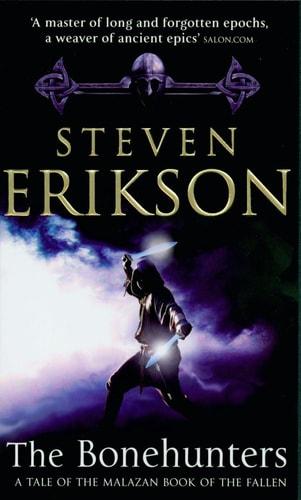
24 chapters - View chapters and summaries
Characters (90)
| Name | Role |
|---|---|
Agayla Witch of Malaz City and Bottle's great-aunt. Keeps an apothecary in the Mouse Quarter and intervenes during the Wickan pogroms. | Supporting |
Ahlrada Ahn Tiste Andii infiltrator hidden as a Hiroth Edur warrior. Knows the truth of the ancient Edur betrayal of the Andii at the K'Chain Che'Malle war. | Supporting |
Apsalar A young fisher's daughter from a coastal village who was possessed by the god Cotillion and used as an instrument of assassination before being encountered by the Bridgeburners. Apsalar is defined by the difficulty of reclaiming an identity after it has been occupied by something else, and by skills she did not choose and cannot entirely discard. | Major |
Balm Sergeant of the 9th squad. Dal Honese, prone to wandering attention but a competent commander when it counts. | Supporting |
Banaschar A former priest of D'rek, the Worm of Autumn, who has fallen into alcoholism after the destruction of his temple and the murder of his fellow priests. Banaschar carries knowledge about the machinations of the gods that makes him both valuable and endangered. | Supporting |
Barathol Mekhar A blacksmith and former soldier living in exile in Seven Cities. Barathol is Kalam's cousin, a massive man with a gentle disposition who is drawn back into conflict despite his desire for a quiet life. | Supporting |
Blistig The Fist commanding the Aren garrison. Blistig is a competent officer who finds himself increasingly frustrated by High Fist Pormqual's cowardice and political manoeuvring as the rebellion closes in on the last Malazan stronghold in Seven Cities. | Supporting |
Boatfinder Anibar tribesman who guides Karsa Orlong and Samar Dev through the northern wastes. | Supporting |
Bottle A young Malazan mage in the 14th Army with an unusual connection to spirits and the natural world. Bottle's magic is instinctive rather than formal, drawing on a talent for communicating with animals and spirits that makes him valuable for reconnaissance. | Minor |
Braven Tooth Master Sergeant of Malaz City's training yard, where every Malazan marine learns their name. Old comrade of Whiskeyjack and Dassem. | Supporting |
Cartheron Crust Old Guard admiral of the Malazan Empire, presumed dead. Spars with Banaschar at Coop's Hanged Man Inn and ferries the Wickans from Malaz City. | Supporting |
| Minor | |
Corabb Bhilan Thenu'alas A warrior devoted to Leoman of the Flails within the Whirlwind rebellion. Corabb is brave, loyal, and somewhat simple in his devotion, following Leoman with an unquestioning faith that will be tested by events. | Minor |
Cotillion One of the two gods who rule the Realm of Shadow, Cotillion is the patron of assassins and one of the sequence's most active divine participants in mortal affairs. Where Shadowthrone operates through misdirection, Cotillion is more direct - he intervenes personally and is bound by a personal code that distinguishes him from the series' more purely transactional divine figures. | Major |
Crokus Younghand A young thief operating across Darujhistan's rooftops, Crokus Younghand is drawn into events considerably beyond his experience when a routine theft places him at the intersection of imperial and divine interest in the city. He is defined by the combination of competence in his chosen field and complete unpreparedness for everything surrounding it. | Supporting |
Crump Heavy infantry demolitionist (real name Jamber Bole) attached to the 14th. Famous for rigging too many cussers at Y'Ghatan. | Supporting |
| Minor | |
| Minor | |
Dejim Nebrahl A D'ivers T'rolbarahl - a shapeshifter of immense power that fragments into multiple predatory forms. Dejim Nebrahl is unleashed as a weapon against Icarium and represents one of the ancient terrors of the Malazan world. | Minor |
Dujek Onearm The High Fist commanding the Malazan forces on Genabackis, Dujek Onearm is one of the empire's most capable military commanders - trusted by his soldiers rather than, necessarily, by his empress. He operates at the intersection of military necessity and political reality, aware that the orders he receives and the situation on the ground rarely align. | Major |
Showing 1 to 20 of 90 items
Page 1 of 5
Groups (10)
| Name | Type |
|---|---|
| Groups in Malazan Book of the Fallen (series) | |
| Circle of Kruppe | Community |
| The Anti-Malazan Alliance | Organisation |
| The Bonehunters | Faction |
| The Bridgeburners | Faction |
| The Claw | Organisation |
| The Malazan Empire | Organisation |
| The Realm of Shadow | Faction |
| The T'lan Imass | Faction |
| The T'orrud Cabal | Organisation |
| Tiste Andii | Faction |
History
| Date | Event | Details |
|---|---|---|
6 March 2006 | Publication | The Bonehunters received strong reviews that acknowledged its scale and scope while noting the demands it placed on readers who had followed the sequence to its sixth volume. At the time of publication the longest book in the series, it was praised for the ambition of its construction - multiple storylines on multiple continents, gradually converging - and for the sustained quality of its set pieces. The novel's treatment of the Bonehunters themselves drew consistent praise: Tavore's army had become one of the series' most compelling collective protagonists, their loyalty to a commander they cannot read and a mission they cannot understand functioning as the emotional spine of the second half of the sequence. Critics noted that The Bonehunters represented the point at which the series' full architecture began to become legible, the earlier books retroactively clarified by what was now visible. |
2007 | Award Nominated | SF Site Readers Poll SF/fantasy book category. 5th place. |
Publication6 March 2006
The Bonehunters received strong reviews that acknowledged its scale and scope while noting the demands it placed on readers who had followed the sequence to its sixth volume. At the time of publication the longest book in the series, it was praised for the ambition of its construction - multiple storylines on multiple continents, gradually converging - and for the sustained quality of its set pieces. The novel's treatment of the Bonehunters themselves drew consistent praise: Tavore's army had become one of the series' most compelling collective protagonists, their loyalty to a commander they cannot read and a mission they cannot understand functioning as the emotional spine of the second half of the sequence. Critics noted that The Bonehunters represented the point at which the series' full architecture began to become legible, the earlier books retroactively clarified by what was now visible.
Award Nominated2007
SF Site Readers Poll
SF/fantasy book category. 5th place.