His Last Bow
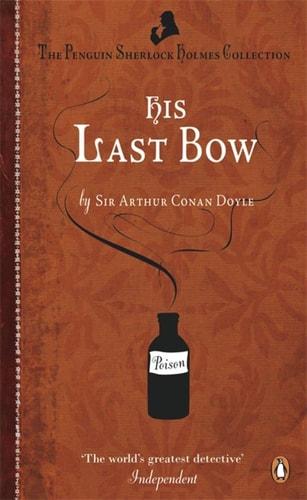
7 stories - View chapters and summaries
Characters (8)
| Name | Aliases | Role |
|---|---|---|
 Dr John H. Watson Army surgeon invalided home from Afghanistan who becomes Sherlock Holmes's companion, lodger, and chronicler. Steady, decent, and possessed of considerable courage, he serves as both the practical counterweight to Holmes's eccentricity and the reader's point of entry into a world that would otherwise be entirely alien. Narrator of the overwhelming majority of the canonical stories. | John Watson, Dr Watson, John H. Watson | Protagonist |
 Sherlock Holmes The world's only consulting detective, operating from 221B Baker Street, London. Possessed of extraordinary powers of observation and deductive reasoning, he applies a rigorous scientific method to criminal investigation while remaining largely indifferent to conventional social expectations. Capable of brilliant warmth and profound coldness in equal measure, his partnership with Dr Watson is the central relationship of the canon. | Mr Sherlock Holmes, Sigerson, Captain Basil | Protagonist |
 Colonel Sebastian Moran Former Colonel of the First Bangalore Pioneers and big game hunter, described by Holmes as the second most dangerous man in London after Moriarty. Chief of staff to Moriarty's criminal organisation. Appears in The Adventure of the Empty House. | Colonel Moran, Sebastian Moran | Antagonist |
 Professor James Moriarty A former Professor of Mathematics turned criminal mastermind, described by Holmes as the Napoleon of Crime - the organising intelligence behind much of London's serious criminality. Appears directly in only a handful of stories but casts a shadow across the later canon. | The Napoleon of Crime, Professor Moriarty | Antagonist |
 Inspector Lestrade Scotland Yard's most prominent inspector in the canon and Holmes's most frequent professional contact within the official police. Tenacious and not without competence, but habitually out of his depth on the cases that matter most, he represents the institutional approach to detection that Holmes consistently outpaces. His relationship with Holmes evolves from grudging tolerance to genuine respect across the canon. | G. Lestrade, Inspector G. Lestrade | Supporting |
 Irene Adler An American opera singer and adventuress who appears in a single story, A Scandal in Bohemia, but earns a permanent place in the canon. Referred to thereafter simply as The Woman. Her prominence in adaptation far exceeds her actual canonical presence, but her impact on Holmes's characterisation is genuine and lasting. | The Woman, Irene Norton | Supporting |
 Mrs Hudson Landlady of 221B Baker Street and the domestic anchor of Holmes's unconventional household. Tolerates her tenant's erratic hours, dangerous visitors, and destructive experiments with remarkable equanimity. More resilient and resourceful than her role suggests, she is a constant presence across the canon without ever being its focus. | Supporting | |
 Mycroft Holmes Sherlock Holmes's elder brother, possessed of even greater powers of observation and deduction but entirely lacking his sibling's energy or inclination to act on them. A founding member of the Diogenes Club and a figure of considerable, deliberately vague importance within the British government - Holmes suggests at one point that Mycroft occasionally is the British government. Appears rarely but significantly. | Mr Mycroft Holmes | Supporting |
Groups (2)
| Name | Type |
|---|---|
| Groups in Sherlock Holmes (universe) | |
| Moriarty's Organisation | Organisation |
| Scotland Yard | Organisation |
History
| Date | Event | Details |
|---|---|---|
October 1917 | Publication | Reception on publication was respectful rather than enthusiastic, the collection arriving during wartime without the cultural fanfare of earlier Holmes publications. The title story attracted particular attention for its patriotic framing and its valedictory tone, with contemporary reviewers noting its departure from the standard Watson-narrated format. Modern critical assessment regards His Last Bow as the most uneven collection after the Case-Book, containing The Adventure of the Bruce-Partington Plans which is consistently ranked among the canon's best alongside several stories considered among its weakest. The title story itself divides critical opinion - its emotional register is recognised as unique within the canon but its merits as a mystery are considered slight. |
PublicationOctober 1917
Reception on publication was respectful rather than enthusiastic, the collection arriving during wartime without the cultural fanfare of earlier Holmes publications. The title story attracted particular attention for its patriotic framing and its valedictory tone, with contemporary reviewers noting its departure from the standard Watson-narrated format. Modern critical assessment regards His Last Bow as the most uneven collection after the Case-Book, containing The Adventure of the Bruce-Partington Plans which is consistently ranked among the canon's best alongside several stories considered among its weakest. The title story itself divides critical opinion - its emotional register is recognised as unique within the canon but its merits as a mystery are considered slight.