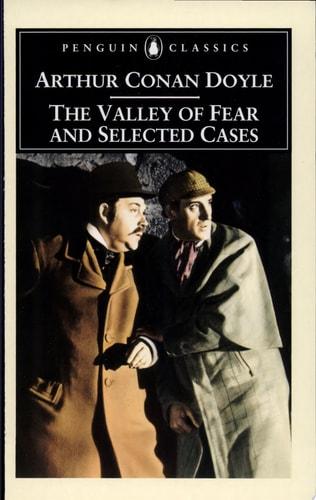
The Valley of Fear
14 chapters - View chapters and summaries
Characters (7)
| Name | Aliases | Role |
|---|---|---|
 Dr John H. Watson Army surgeon invalided home from Afghanistan who becomes Sherlock Holmes's companion, lodger, and chronicler. Steady, decent, and possessed of considerable courage, he serves as both the practical counterweight to Holmes's eccentricity and the reader's point of entry into a world that would otherwise be entirely alien. Narrator of the overwhelming majority of the canonical stories. | John Watson, Dr Watson, John H. Watson | Protagonist |
 Sherlock Holmes The world's only consulting detective, operating from 221B Baker Street, London. Possessed of extraordinary powers of observation and deductive reasoning, he applies a rigorous scientific method to criminal investigation while remaining largely indifferent to conventional social expectations. Capable of brilliant warmth and profound coldness in equal measure, his partnership with Dr Watson is the central relationship of the canon. | Mr Sherlock Holmes, Sigerson, Captain Basil | Protagonist |
 Colonel Sebastian Moran Former Colonel of the First Bangalore Pioneers and big game hunter, described by Holmes as the second most dangerous man in London after Moriarty. Chief of staff to Moriarty's criminal organisation. Appears in The Adventure of the Empty House. | Colonel Moran, Sebastian Moran | Antagonist |
 Professor James Moriarty A former Professor of Mathematics turned criminal mastermind, described by Holmes as the Napoleon of Crime - the organising intelligence behind much of London's serious criminality. Appears directly in only a handful of stories but casts a shadow across the later canon. | The Napoleon of Crime, Professor Moriarty | Antagonist |
Ted Baldwin An American whose appearance at Birlstone Manor is the inciting incident of the murder investigation at the centre of The Valley of Fear. His connection to John Douglas and to the events described in Part 2 of the novel becomes clear as Holmes's investigation progresses. Appears in The Valley of Fear only. | Antagonist | |
John Douglas The owner of Birlstone Manor whose apparent murder brings Holmes and Watson to Sussex at the opening of The Valley of Fear. A man of considerable physical presence and personal courage whose history proves considerably more complex than it initially appears. Appears in The Valley of Fear only. | Birdy Edwards | Supporting |
 Mrs Hudson Landlady of 221B Baker Street and the domestic anchor of Holmes's unconventional household. Tolerates her tenant's erratic hours, dangerous visitors, and destructive experiments with remarkable equanimity. More resilient and resourceful than her role suggests, she is a constant presence across the canon without ever being its focus. | Supporting |
Groups (2)
| Name | Type |
|---|---|
| Groups in Sherlock Holmes (universe) | |
| Moriarty's Organisation | Organisation |
| Scotland Yard | Organisation |
History
| Date | Event | Details |
|---|---|---|
September 1914 | Publication | Reception was solid and respectful rather than enthusiastic. Serialisation in the Strand Magazine drew reliable readership but by 1914 Holmes was an institution and the novel was received as a dependable addition rather than an event. Contemporary reviewers noted the structural similarity to A Study in Scarlet and opinion divided on whether the American flashback section strengthened or diluted the main investigation. Modern critical assessment places it third of the four novels, above The Sign of Four in most rankings, valued for the Moriarty framing and the American section's historical grounding. |
PublicationSeptember 1914
Reception was solid and respectful rather than enthusiastic. Serialisation in the Strand Magazine drew reliable readership but by 1914 Holmes was an institution and the novel was received as a dependable addition rather than an event. Contemporary reviewers noted the structural similarity to A Study in Scarlet and opinion divided on whether the American flashback section strengthened or diluted the main investigation. Modern critical assessment places it third of the four novels, above The Sign of Four in most rankings, valued for the Moriarty framing and the American section's historical grounding.