The Return of Sherlock Holmes
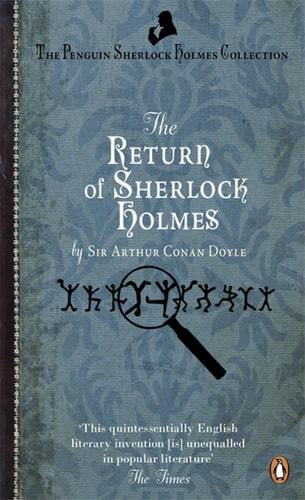
13 stories - View chapters and summaries
Characters (10)
| Name | Aliases | Role |
|---|---|---|
 Dr John H. Watson Army surgeon invalided home from Afghanistan who becomes Sherlock Holmes's companion, lodger, and chronicler. Steady, decent, and possessed of considerable courage, he serves as both the practical counterweight to Holmes's eccentricity and the reader's point of entry into a world that would otherwise be entirely alien. Narrator of the overwhelming majority of the canonical stories. | John Watson, Dr Watson, John H. Watson | Protagonist |
 Sherlock Holmes The world's only consulting detective, operating from 221B Baker Street, London. Possessed of extraordinary powers of observation and deductive reasoning, he applies a rigorous scientific method to criminal investigation while remaining largely indifferent to conventional social expectations. Capable of brilliant warmth and profound coldness in equal measure, his partnership with Dr Watson is the central relationship of the canon. | Mr Sherlock Holmes, Sigerson, Captain Basil | Protagonist |
Abe Slaney An American criminal whose pursuit of a woman from his past brings violence to a quiet Norfolk farm in The Adventure of the Dancing Men. His use of a coded message system based on stick figures dancing - the dancing men of the title - gives Holmes one of his most celebrated cryptographic challenges. Dangerous and entirely without scruple about pursuing what he considers his by prior claim. | Antagonist | |
 Colonel Sebastian Moran Former Colonel of the First Bangalore Pioneers and big game hunter, described by Holmes as the second most dangerous man in London after Moriarty. Chief of staff to Moriarty's criminal organisation. Appears in The Adventure of the Empty House. | Colonel Moran, Sebastian Moran | Antagonist |
 Professor James Moriarty A former Professor of Mathematics turned criminal mastermind, described by Holmes as the Napoleon of Crime - the organising intelligence behind much of London's serious criminality. Appears directly in only a handful of stories but casts a shadow across the later canon. | The Napoleon of Crime, Professor Moriarty | Antagonist |
Hilton Cubitt A Norfolk squire of old family who comes to Holmes with a curious problem - a series of stick figure drawings appearing on his property that have thrown his American wife into a state of terror she refuses to explain. Straightforward, decent, and entirely out of his depth in the situation his wife's past has brought to his door. Appears in The Adventure of the Dancing Men only. | Supporting | |
 Inspector Hopkins A young and promising Scotland Yard inspector whom Holmes regards as one of the best of the official force. Appears across several cases in The Return of Sherlock Holmes, where he frequently brings difficult cases to Holmes while remaining open to methods that his more senior colleagues would dismiss. Represents a younger, more adaptable face of official detection. | Stanley Hopkins | Supporting |
 Inspector Lestrade Scotland Yard's most prominent inspector in the canon and Holmes's most frequent professional contact within the official police. Tenacious and not without competence, but habitually out of his depth on the cases that matter most, he represents the institutional approach to detection that Holmes consistently outpaces. His relationship with Holmes evolves from grudging tolerance to genuine respect across the canon. | G. Lestrade, Inspector G. Lestrade | Supporting |
 Mrs Hudson Landlady of 221B Baker Street and the domestic anchor of Holmes's unconventional household. Tolerates her tenant's erratic hours, dangerous visitors, and destructive experiments with remarkable equanimity. More resilient and resourceful than her role suggests, she is a constant presence across the canon without ever being its focus. | Supporting | |
 Mycroft Holmes Sherlock Holmes's elder brother, possessed of even greater powers of observation and deduction but entirely lacking his sibling's energy or inclination to act on them. A founding member of the Diogenes Club and a figure of considerable, deliberately vague importance within the British government - Holmes suggests at one point that Mycroft occasionally is the British government. Appears rarely but significantly. | Mr Mycroft Holmes | Supporting |
Groups (2)
| Name | Type |
|---|---|
| Groups in Sherlock Holmes (universe) | |
| Moriarty's Organisation | Organisation |
| Scotland Yard | Organisation |
History
| Date | Event | Details |
|---|---|---|
17 March 1905 | Publication | Reception was enthusiastic on publication, driven by strong public appetite for new Holmes stories. The opening story drew enormous readership to the Strand Magazine and the collection sold strongly. Contemporary reviewers were generally positive while noting that the circumstances of resurrection required some narrative contrivance. Modern critical assessment is more measured - the collection is considered uneven, with a handful of stories matching the best of the earlier work and others falling short. The Adventure of the Dancing Men and The Adventure of the Six Napoleons are consistently ranked among the canon's finest; several others are regarded as minor. The Return is generally placed third in critical rankings of the five collections. |
Publication17 March 1905
Reception was enthusiastic on publication, driven by strong public appetite for new Holmes stories. The opening story drew enormous readership to the Strand Magazine and the collection sold strongly. Contemporary reviewers were generally positive while noting that the circumstances of resurrection required some narrative contrivance. Modern critical assessment is more measured - the collection is considered uneven, with a handful of stories matching the best of the earlier work and others falling short. The Adventure of the Dancing Men and The Adventure of the Six Napoleons are consistently ranked among the canon's finest; several others are regarded as minor. The Return is generally placed third in critical rankings of the five collections.